Introduction
Spouted Pouches are widely used in the food, beverage, pharmaceutical, and chemical industries due to their convenience, flexibility, and barrier properties. Ensuring that these packages remain sealed and leak-free throughout their lifecycle is critical for product safety and quality. Vacuum Decay Testing is a leading non-destructive method to detect leaks in spouted pouches and other flexible packaging, providing reliable data on seal integrity and material performance.
Understanding Vacuum Decay Testing
Vacuum Decay Testing involves placing a sealed package inside a vacuum chamber. The chamber is isolated from the vacuum source, and a sensitive pressure transducer monitors changes in vacuum over time. Any rise in chamber pressure indicates a leak in the package, as headspace gas escapes through imperfections or seal junctures. This method allows for Micro Leak Detection without the need for dyes, gases, or other invasive testing materials.
ASTM F2338 provides a standardized framework for performing vacuum decay tests, including equipment setup, calibration, and data interpretation. Following this standard ensures that results are accurate, reproducible, and suitable for research, development, or quality control purposes.
Test Procedure for Spouted Pouches
The testing procedure begins with proper package placement inside the vacuum chamber. Key steps include:
- Chamber Preparation: Isolate the chamber from the vacuum source once the desired vacuum level is reached. Monitor the absolute or differential pressure transducers to track changes over time.
- Masking Porous Surfaces: For spouted pouches with porous barriers, it is necessary to mask or block these areas to prevent gas migration that could interfere with results. Proper masking ensures that vacuum decay readings reflect genuine leaks in the package or seals.
- Observation and Recording: Vacuum decay occurs when gas or vapor escapes from the package. The pressure change is continuously recorded, and packages exceeding acceptable limits are flagged via audible or visual indicators.
- Non-Destructive Evaluation: One of the advantages of vacuum decay testing is its non-invasive nature. Packages remain intact, allowing for further handling, filling, or distribution if no leaks are detected.
Common Challenges and Interpretation of Results
While Vacuum Decay Testing is highly sensitive, it is important to understand factors that may influence the results. For example, trapped air between layers of laminated materials or viscous liquids inside the pouch can cause transient vacuum changes that are not actual leaks. Similarly, the flexibility of the pouch may affect the pressure readings. To accurately interpret results, operators should differentiate between genuine leaks and background noise, and confirm repeatability across multiple samples. Proper calibration of the Micro Leak Detection system, adherence to ASTM F2338 guidelines, and careful masking of porous areas help ensure reliable measurements and prevent false positives.
Significance of Micro Leak Detection
Leaks in spouted pouches can compromise product quality and safety, leading to oxidation, microbial contamination, or spillage. The vacuum decay method is essential for identifying:
- Seal Failures: Imperfections at the junction of spout and pouch or along heat seals.
- Material Defects: Tiny pinholes or weak spots in the packaging film.
- Process Optimization Needs: Insights to refine sealing parameters or material selection.
Applications and Benefits
Vacuum decay testing is widely applicable across industries:
- Food & Beverage: Detect leaks that may reduce shelf life or spoil contents.
- Pharmaceuticals: Ensure sterility and dosage accuracy by verifying pouch integrity.
- Consumer Goods: Maintain brand reputation through consistent quality control.
Using a reliable instrument like the Cell Instruments MLT-01 Micro Leak Tester streamlines testing with high accuracy and efficiency. The MLT-01 offers:
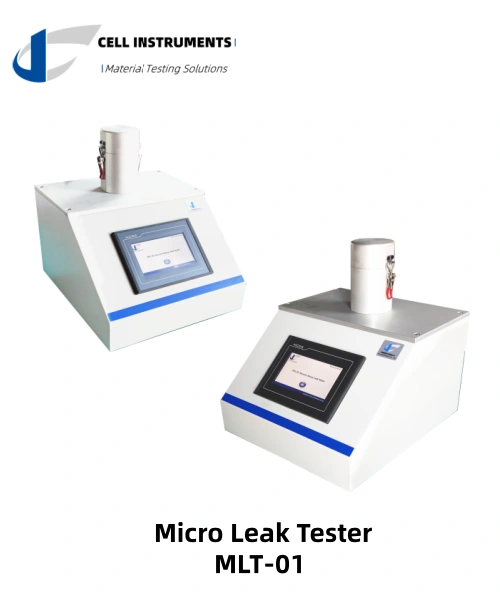
- Rapid Testing: Evaluate packages in seconds for 100% online testing or statistical sampling.
- Precise Results: Detect leaks invisible to the naked eye through sensitive pressure measurement.
- Ease of Operation: Semi-automatic or automatic testing modes improve productivity and reduce human error.
Conclusion
Maintaining the integrity of spouted pouches is critical for safety, quality, and customer satisfaction. Vacuum Decay Testing, as defined by ASTM F2338, provides a rapid, non-destructive, and reliable method for detecting micro leaks. Implementing this testing with advanced tools like the Cell Instruments MLT-01 Micro Leak Tester ensures accurate results, helps optimize packaging processes, and protects products from potential contamination or damage.
By incorporating vacuum decay testing into production and quality control workflows, manufacturers can confidently deliver safe, high-quality products, reinforcing trust with consumers and regulatory bodies.
 EN
EN  AR
AR  BG
BG  CS
CS  DA
DA  DE
DE  EL
EL  ES
ES  ET
ET  FI
FI  FR
FR  HU
HU  ID
ID  IT
IT  JA
JA  KO
KO  LT
LT  LV
LV  NB
NB  NL
NL  PL
PL  PT
PT  RO
RO  RU
RU  SK
SK  SL
SL  SV
SV  TR
TR  UK
UK