In industries such as pharmaceuticals, medical devices, and food packaging, ensuring that products are safely sealed and free from leaks is critical. One of the most effective methods for detecting leaks in packaging is vacuum decay testing. For IV bags, this non-destructive test is essential in ensuring product integrity, safeguarding both the contents and the end-user. In this article, we’ll explore how vacuum decay testing, in line with ASTM F2338, helps in micro leak detection, and why it is the preferred choice for testing the quality of IV bags and other packaging materials.
Understanding Vacuum Decay Testing for IV Bags
Vacuum decay testing is a process used to detect leaks in sealed packaging by monitoring the changes in pressure inside a vacuum chamber. The IV bags are placed inside a vacuum chamber, and the vacuum is applied. As the vacuum is applied, the pressure transducer measures any decay in the vacuum over time, indicating the presence of leaks.
Leaks are typically the result of imperfections in the packaging material or the sealing process. These small imperfections, often invisible to the naked eye, can lead to contamination or spoilage of the product. Vacuum decay testing provides a reliable method for detecting these leaks, especially micro leaks, which may be too small to be detected using traditional methods.
How Does Vacuum Decay Testing Work?
The IV bag sample is placed in a vacuum chamber, where a vacuum is applied. A pressure transducer monitors the vacuum level inside the chamber. If the IV bag has any leaks, the headspace gas inside the bag will begin to escape, leading to a drop in pressure in the chamber. This pressure change is then measured by the pressure transducer, which provides data on the size and severity of the leak.
The vacuum decay method can detect even the smallest of leaks, making it especially useful for packaging materials where leaks can compromise the sterility or integrity of the product.
ASTM F2338 and Its Role in Vacuum Decay Testing
ASTM F2338 outlines the standardized method for vacuum decay testing, providing guidelines for testing IV bags and other sealed packaging. This method allows for the detection of leaks that are not visible to the naked eye, offering a non-destructive and reliable way to ensure packaging integrity.
According to ASTM F2338, the test procedure involves the following steps:
- Vacuum Application: The IV bag is placed inside a vacuum chamber, and the chamber is then evacuated to a specified vacuum level.
- Pressure Monitoring: A pressure transducer is used to monitor the vacuum inside the chamber. Any changes in the pressure indicate gas or vapor ingress from the IV bag.
- Time Measurement: The chamber is maintained at the vacuum level for a set time, allowing any leaks to be detected. The rate of pressure change during this period helps identify the size of the leak.
- Analysis: Once the test is complete, the results are analyzed. If the vacuum decay rate exceeds the acceptable limits, an audible or visual signal is triggered, indicating that the package has failed the test.
The Role of the Cell Instruments Vacuum Leakage Tester
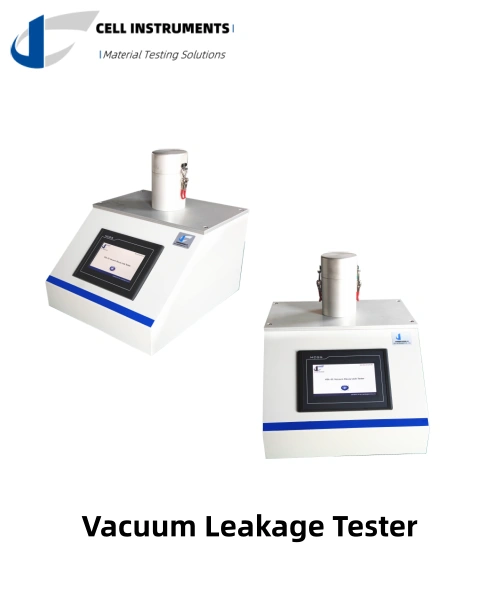
For manufacturers of IV bags and other sealed packaging, having a reliable vacuum leakage tester is essential. The Cell Instruments Vacuum Leakage Tester is an ideal solution for performing vacuum decay testing in line with ASTM F2338. This tester provides accurate and efficient results, allowing for the quick detection of leaks in IV bags and other packaging materials.
Features of the Cell Instruments Vacuum Leakage Tester
- Precision Measurement: The tester uses advanced pressure transducers to measure vacuum decay with high accuracy, ensuring that even the smallest leaks are detected.
- Non-destructive Testing: The Cell Instruments Vacuum Leakage Tester is designed to test IV bags and other packaging materials without damaging them, preserving their integrity for further use.
- User-Friendly Interface: With an intuitive interface, the tester is easy to operate, reducing the time and effort required for training staff and conducting tests.
- Customizable Settings: The tester allows users to adjust test parameters, such as vacuum levels and test duration, to meet the specific requirements of different packaging materials.
Conclusion
Vacuum decay testing is an essential tool for ensuring the integrity of IV bags and other sealed packaging materials. By detecting micro leaks that may not be visible to the naked eye, vacuum decay testing ensures that products remain safe and effective for use. With ASTM F2338 as a guiding standard, manufacturers can confidently rely on this method to maintain packaging quality and meet regulatory requirements.
For accurate, efficient, and non-destructive testing, the Cell Instruments Vacuum Leakage Tester is an excellent choice, offering reliable results and seamless integration into production lines. Ensuring that IV bags and other packaging materials are leak-free is critical in maintaining the safety and quality of medical and pharmaceutical products.
 EN
EN  AR
AR  BG
BG  CS
CS  DA
DA  DE
DE  EL
EL  ES
ES  ET
ET  FI
FI  FR
FR  HU
HU  ID
ID  IT
IT  JA
JA  KO
KO  LT
LT  LV
LV  NB
NB  NL
NL  PL
PL  PT
PT  RO
RO  RU
RU  SK
SK  SL
SL  SV
SV  TR
TR  UK
UK