Flexible pouches have become one of the most widely used packaging formats in food, pharmaceutical, and medical device industries. Their lightweight structure, material efficiency, and excellent barrier performance make them ideal for modern distribution systems. However, these advantages rely heavily on reliable seals and material integrity. Even microscopic leaks can compromise shelf life, sterility, or product safety. This is where vacuum decay testing plays a crucial role.
Vacuum decay testing offers a non-destructive, quantitative approach to evaluating the integrity of flexible pouches. By understanding its principles, procedures, and relevant standards, quality control professionals can confidently apply this method to daily inspection and process optimization.
What Is Vacuum Decay Testing?
Vacuum Decay Testing measures changes in pressure within a sealed test chamber after vacuum application. When a flexible pouch contains a leak, gas escapes from the package into the chamber, causing a measurable rise in pressure over time. This pressure change, known as vacuum decay, forms the basis for leak detection.
Unlike visual methods, vacuum decay testing provides objective data rather than subjective interpretation. It does not require dyes, gases, or liquids, making it clean and suitable for sensitive packaging applications.
Why ASTM F2338 Matters
ASTM F2338 defines standardized procedures and principles for vacuum decay testing of packages. The standard emphasizes monitoring vacuum level and pressure change over time using sensitive transducers. It also explains how package design, contents, and test parameters influence sensitivity.
By following ASTM F2338, manufacturers align testing practices with internationally recognized methods, strengthening audit readiness and result credibility.
Role of Leak and Seal Strength Tester Systems
A Leak and Seal Strength Tester configured for vacuum decay integrates a sealed chamber, vacuum source, and high-resolution pressure sensors. This system allows precise control of test pressure, time, and acceptance criteria. For flexible pouches, such testers help detect leaks that remain invisible during visual inspection while preserving the package for further evaluation.
Why Vacuum Decay Testing Is Critical for Flexible Pouches
Flexible pouches often contain headspace gas and rely on thin, multilayer films. These characteristics make them efficient but also sensitive to sealing variations. Vacuum decay testing addresses several critical needs:
- Detection of micro-leaks that compromise barrier performance
- Non-destructive evaluation, allowing retesting or further analysis
- Objective results, reducing operator dependency
- Process optimization, supporting seal parameter adjustment
For regulated industries, vacuum decay testing strengthens confidence in package integrity without adding complexity to production workflows.
Test Principle Explained Simply
During vacuum decay testing, a flexible pouch is placed inside a sealed chamber. Vacuum is applied to reach a defined pressure level, then the chamber is isolated from the vacuum source. Sensitive pressure transducers monitor any change in chamber pressure.
If the pouch is intact, pressure remains stable within defined limits. If a leak exists, gas escapes from the pouch, causing pressure to rise. The rate and magnitude of this change indicate package integrity.
ASTM F2338 highlights that vacuum decay may also result from background factors, such as vapor release from liquids. Proper test pressure selection helps distinguish true leaks from background noise.
Factors Affecting Test Sensitivity
ASTM F2338 emphasizes that sensitivity depends on multiple variables:
- Package design, including material flexibility and headspace volume
- Test chamber volume, with smaller voids improving detection limits
- Pressure transducer sensitivity, critical for micro-leak detection
- Test time and pressure, influencing the ability to differentiate leaks from noise
For flexible pouches, restricting excessive package expansion during testing helps reduce background variation and improves accuracy.
Advantages Compared with Traditional Leak Tests
Vacuum decay testing offers several benefits over dye penetration or bubble tests:
- No immersion fluids or dyes
- No visual interpretation bias
- Suitable for automated or semi-automated testing
- Applicable in both laboratory and production environments
These advantages make vacuum decay testing especially attractive for high-throughput operations involving flexible pouches.
Equipment Considerations for Reliable Results
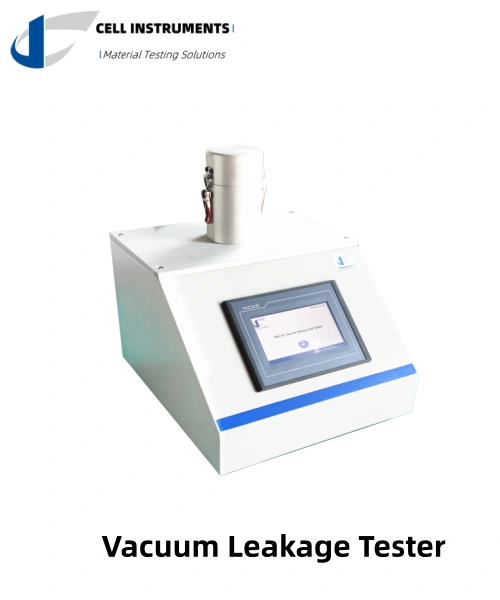
Reliable results depend on stable vacuum control, accurate pressure sensing, and robust data processing. The Cell Instruments Vacuum Leakage Tester is designed to support vacuum decay testing in accordance with ASTM F2338. Its precise pressure measurement and optimized chamber design help quality teams detect leaks in flexible pouches with confidence, while maintaining non-destructive testing conditions suitable for ongoing quality monitoring.
Rather than focusing only on detection, such systems also support process validation and seal optimization, adding long-term value to packaging operations.
Conclusion
Flexible pouches demand reliable, sensitive, and repeatable integrity testing to protect product quality and brand reputation. Vacuum decay testing, guided by ASTM F2338, provides a scientifically sound and non-destructive method to detect leaks that other techniques may miss. When combined with appropriate equipment and well-defined procedures, vacuum decay testing becomes an indispensable tool for modern packaging quality control.
 EN
EN  AR
AR  BG
BG  CS
CS  DA
DA  DE
DE  EL
EL  ES
ES  ET
ET  FI
FI  FR
FR  HU
HU  ID
ID  IT
IT  JA
JA  KO
KO  LT
LT  LV
LV  NB
NB  NL
NL  PL
PL  PT
PT  RO
RO  RU
RU  SK
SK  SL
SL  SV
SV  TR
TR  UK
UK